

What to Look for When Choosing a Skilled Nursing Care Facility
Request CareWhat to Look for When Choosing a Skilled Nursing Care Facility
Choosing a skilled nursing care facility often happens in the wake of a health crisis, like an unexpected fall, a stroke, or a surgery.
In these high-pressure moments, many families choose a facility based on a rushed recommendation from a hospital social worker or a quick Google search through a few websites filled with photos of pristine furniture and smiling elderly people.
By using objective data and your own “boots-on-the-ground” observations, you can find a facility that provides the high-quality, skilled nursing care your loved one deserves. Whether you have two days or two weeks to make a decision, this guide helps you navigate the process with ease.
Let’s dive in.
Understanding the Needs Assessment
Before you start comparing skilled nursing care facilities, it helps to have a clear picture of what your loved one actually needs, and that starts with understanding the needs assessment.
When a patient is discharged from the hospital, the clinical team evaluates their functional status, medical complexity, and what level of support they’ll require going forward. That assessment drives the recommendation for skilled nursing care, but it also determines what kind of facility is the best fit.
Skilled nursing care facilities generally offer two types of care:
- Short-term care is for people recovering from surgery, acute illness, or hospitalization who need skilled nursing or rehabilitation services, like physical therapy, wound care, or medication management, before returning home.
- Long-term care is for people who need ongoing assistance with daily activities or continuous nursing supervision due to a chronic condition, progressive illness, or cognitive decline.
While it might feel overwhelming and generally a lot of information to take in, it’s worth asking your loved one’s care team directly about what specific needs are driving the recommendation for skilled nursing care. That conversation will tell you a lot about what to prioritize as you evaluate your options.
Start With the Data
Before you visit a single facility, start with official government data from Medicare's Care Compare. Once on the website, you can select the type of facility you’re looking for, enter your location, and compare facilities side by side.
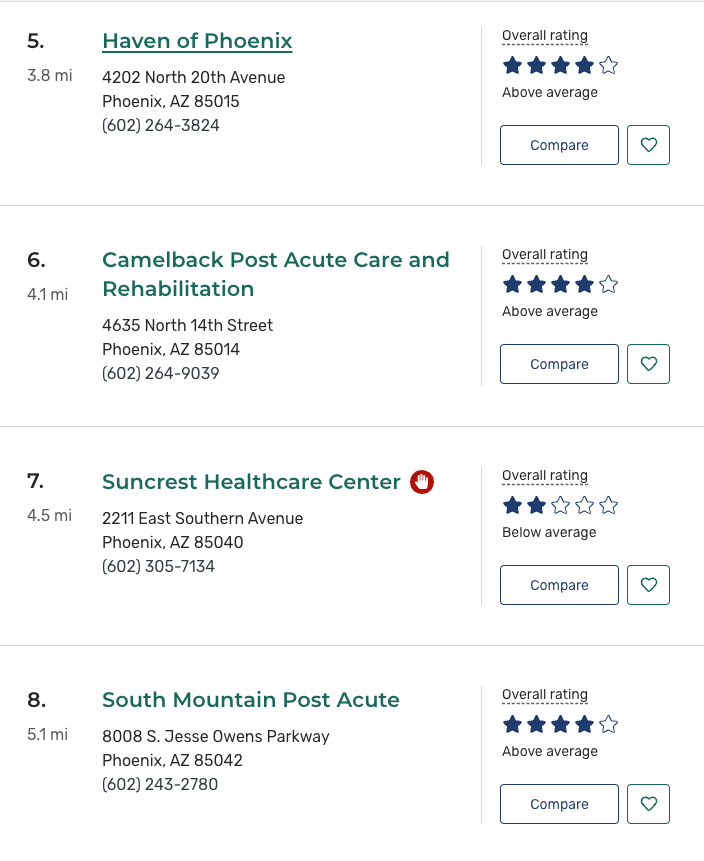
Each skilled nursing care facility receives an overall 1-5 star rating, where 1 star means quality is below average and 5 stars means quality is above average. This rating reflects a facility’s performance during annual comprehensive inspections and during specific investigations triggered by complaints.
The rating system is comprised of three components:
- Health Inspections: Covers yearly health and safety inspections, infection control inspections, and complaint-driven investigations going back three years. Citations for abuse, neglect, or medication errors carry greater weight than citations for administrative violations.
- Staffing Levels: The ratio is based on the hours worked by nursing staff relative to the number of residents, indicating the average time a staff member is available to spend with each resident. It also tracks staff turnover, which may suggest underlying issues if staff are leaving fairly often. Higher hours per resident per day is better; lower staff turnover is better.
- Quality Measures: Track specific outcomes that reflect overall performance, such as hospitalization rates, fall injuries, and pressure ulcers. These are facility-wide averages rather than individual case data, but consistent patterns across measures are informative.
Together, these three components give you a more complete picture of each facility. But a facility with an above-average overall rating can still have staffing levels that fall short, or a pattern of complaint citations that the summary score doesn’t reflect. Therefore, it’s important to read each component separately to narrow your list of potential facilities before you visit them.
Staffing: The Single Biggest Predictor of Quality
The most critical factor in your loved one’s safety and the quality of care provided is the team of people providing the care. Unfortunately, research shows that 87% of skilled nursing care facilities report moderate to high staffing shortages, and a staggering 98% have found hiring new staff to be a major challenge.
Effective in 2024, the Centers for Medicare & Medicaid Services finalized a rule establishing minimum staffing requirements for long-term care facilities: requiring a minimum of 3.48 total hours per resident per day, with at least 0.55 hours from registered nurses.
However, meeting the minimum requirement should not be the goal.
When ratios are too high (too many patients per nurse), there simply isn’t enough time for individualized skilled nursing care. Essential tasks like medication administration, wound care, and even basic monitoring are more likely to be delayed or omitted entirely. Research suggests that the percentage of clinical care delayed or omitted decreases with greater numbers of licensed nurses (RNs and LPNs) on staff, falling below 10% when hours per resident are between 3.8 and 4.6 (which is more than the minimum requirement).
With that in mind, when comparing facilities on Medicare's Care Compare website, look for a higher ratio of nurse staff hours per resident per day. A higher number means staff have more time to spend with each individual resident, which leads to better identification of a change in condition and a more dignified experience overall for your loved one.
Skilled Nursing Care, Daily Activities, & Resident Preferences
When your loved one is admitted to a skilled nursing care facility, it’s generally because their medical needs require more than what can be managed at home. That might mean they require wound care, IV medications, post-surgical monitoring, management of a complex chronic condition, or rehabilitation from an acute injury.
But not every facility is equally equipped to provide the same level of skilled nursing care. For example, a facility that handles short-term orthopedic rehab well may not have the same depth of experience with neurological conditions. So, be prepared to ask questions regarding what type of care your loved one will receive based on their needs.
A few clinical questions worth asking:
- Does the facility have experience caring for patients with your loved one’s specific diagnosis or condition?
- What rehabilitative services are available on-site—physical, occupational, and speech therapy—and how frequently are they provided?
- What is the protocol when a resident’s condition changes? Who assesses them, how quickly, and who contacts the family?
- How does the facility manage pain, and what is their approach to avoiding unnecessary medications like antipsychotics?
Now, how someone spends their days—and how much say they have in how those days unfold—affects their recovery, mental health, and overall quality of life, just as much as the skilled nursing care provided. When you visit a facility, pay attention to whether residents seem engaged and comfortable.
A few more things worth asking or observing directly:
- What does a typical day look like for a resident at your loved one’s level of care? How much flexibility exists around daily routines?
- Is there a structured activity calendar, and are residents involved in shaping it?
- How does the facility handle dining, food preferences, and dietary restrictions?
- Can residents personalize their space with their own belongings? Is there secure storage for valuables?
- How do staff interact with residents in the hallways?
These details can feel secondary when you’re focused on clinical quality. However, a facility that delivers high-quality clinical care but offers little autonomy, engagement, or decent food isn’t providing holistic care to its residents. It’s reasonable to want and expect the best of both worlds.
Red Flags & What to Pay Attention to On a Tour
Even a facility with expert marketing and a polished front lobby can hide systemic issues that make it unsafe for your loved one.
So, before you even set foot on the property, be aware of these two critical warnings on Medicare’s Care Compare website:
- Abuse Alerts: Look for a red circle with a hand icon. This indicates the facility has been cited for issues related to abuse.
- Special Focus Facilities: A “yellow alert” symbol means the facility has a history of serious quality issues and is under government scrutiny.
While tours can feel a little performative, it’s still worth the time and effort to see the facilities firsthand, ask staff questions, and even meet and speak with some of the residents.
Once you’re on-site, observe the environment itself. Pay attention to these signals that may point to larger operational problems:
- Resident Well-being: Look for residents who appear unattended, under-stimulated, or distressed. Do you see people calling out for help without a response, or residents wandering into unsafe areas unsupervised?
- The "Vibe" of the Staff: High staff turnover is a major red flag; if the facility can't keep its employees, those employees likely know something is amiss. Watch for staff who seem rushed, dismissive, or slow to respond to resident requests.
- Facility Maintenance: Beyond the front lobby, check for cleanliness and condition of the facility as a whole. Strong, lingering odors or safety risks in the hallways suggest that basic maintenance and hygiene may be slipping.
- Evasive Communication: If the administration gives vague or dismissive answers about how they handle medical emergencies or changes in a resident’s condition, it is a sign of poor transparency.
- High-Pressure Tactics: You should never feel pressured to make a decision quickly. You have the right to review the facility’s full health and safety inspection reports before signing any paperwork.
Ultimately, your intuition during a tour is a powerful tool that should be used alongside official data. A high-quality facility should be transparent about its performance and welcome your questions.
Becoming Your Loved One’s Best Advocate
It is so easy to feel overwhelmed and maybe a little rushed when a hospital social worker hands you a list of facilities and asks for a decision by the end of the day.
However, you have agency in this process, and you’re not required to simply accept the first name on a list. By using tools like Medicare’s Care Compare to check star ratings and health inspections, you are transforming an emotional choice into a guided, data-driven decision.
Taking the time to ask questions and look for red flags will give your loved one the best possible outcome. Every question mentioned in this guide—from asking about nurse-to-resident ratios to inquiring about how the facility respects a resident’s preferences—is entirely reasonable. In fact, any facility committed to high-quality care will welcome your diligence as a partner in your loved one’s care.
This transition is undeniably difficult to navigate. If you’re feeling alone in this process, know that Navi Nurses can provide personalized recommendations and help you weigh your options in the Phoenix metropolitan area—including visiting a facility with you or determining whether home-based care might be a viable alternative to a facility stay.
Contact us here for a free consultation.